Vinha Alta: The Newcomer Challenging the Rules of Rum da Madeira
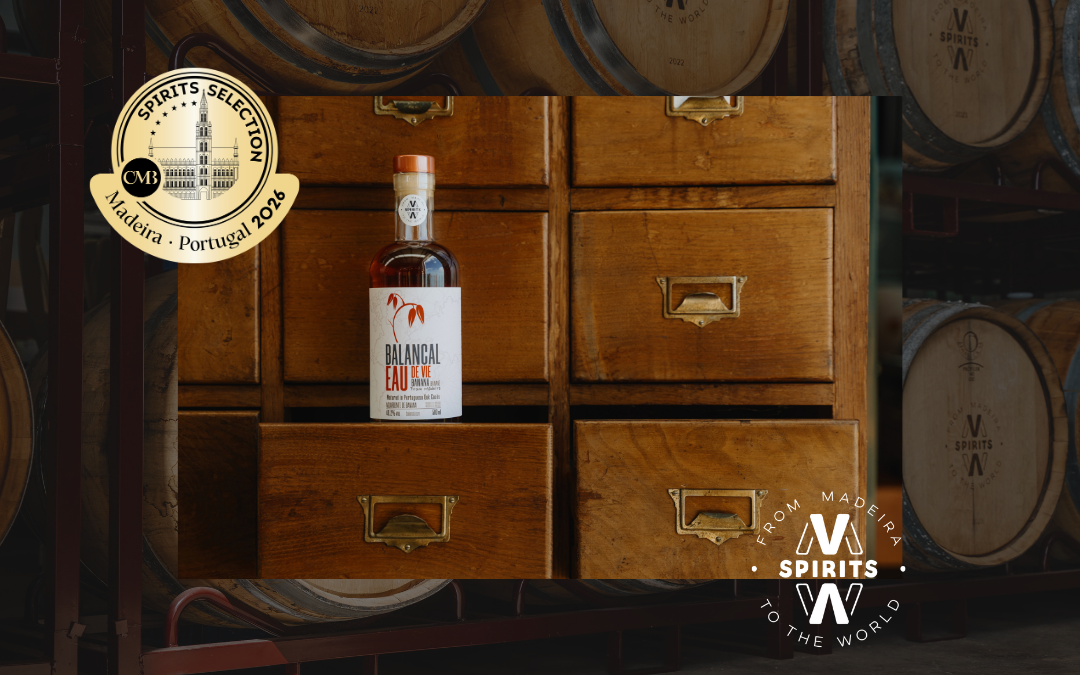
Our tour of Madeira rum continues at Vinha Alta, home of Balancal, although my first encounter with the distillery came through a rather different product: a banana eau-de-vie.
It was an unusual but entirely logical introduction. Bananas are, after all, one of Madeira’s defining crops, cultivated across the island’s terraced slopes alongside sugarcane, citrus and herbs. Balancal’s decision to distil them immediately revealed something important about the producer: this was never going to be a distillery defined by a single category.
The name Balancal comes from the land on which the distillery stands, a sloping field once planted with oats that moved gently in the mountain wind. Today, that same site, framed by stone walls, mist and cultivated terraces, is home to a distinctly modern Madeiran distillery.
Balancal produces fruit and botanical Geist and eaux-de-vie, gin and rum, with whisky now joining the range as its latest expression. Despite that diversity, the underlying idea remains consistent: Madeira should not merely provide the address of the distillery, but the raw materials, climate, casks and sense of place that shape everything it produces.
This makes Vinha Alta rather different from the island’s traditional sugarcane mills. It approaches rum as part of a broader distilling philosophy, combining local ingredients with technical precision and a willingness to question what Rum da Madeira is expected to taste like.
Paulo and Maria describe themselves as the “new kids in town”. They may have arrived late, but Balancal has already set out to occupy a very particular place in Madeira’s distilling landscape.
How would you describe Vinha Alta’s role within the wider story of Rum da Madeira?
We are the “new kids in town”: the maverick producer that arrived late to the party but wants to make a stand.
Our aim is to expand the boundaries of Madeira rum and explore new flavours while maintaining the most stringent distillation standards. We will only market double-distilled rums and will focus increasingly on distinctive expressions, particularly single-cask and vintage-dated, or millésime, rums.
We intend to stay away from rum produced primarily for local poncha and from the conventional sequence of three-, six- or nine-year-old blended expressions.
What is the most important thing people should understand about your distillery before tasting your spirits?
We are not an engenho, or traditional sugarcane mill.
We are an eau-de-vie distillery, and we apply exactly the same approach to rum production. Rum drinkers looking exclusively for a traditional style should perhaps look elsewhere. Adventurous rum explorers, however, should definitely come and visit us.
How does Madeira itself influence your products?
Everything we produce, from our eaux-de-vie to our whisky, is directly connected to local agricultural produce.
Madeira’s climate and soils create a unique environment for the crops grown here, and that identity is reflected in the spirits we produce.
We also age our spirits exclusively in ex-Madeira wine casks and new Portuguese oak. Without this direct connection to Madeira, it would be far more efficient to establish a distillery somewhere in continental Europe rather than on a remote island in the middle of the Atlantic.
What role do sugarcane cultivation, harvest and seasonality play in your production?
We are fully embracing sugarcane cultivation.
As Madeira’s youngest and smallest producer, it is becoming increasingly difficult for us to secure the quality and quantity of sugarcane we require. We have therefore decided that, in future, we will produce rum exclusively from our own sugarcane.
What are the main challenges of producing rum from sugarcane on the island?
On an island with Madeira’s topography, producing any agricultural crop is difficult. Sugarcane is particularly challenging because of the sheer weight of the harvested cane.
The best agricultural land is often also the most attractive land for property development. At the same time, the farming population is ageing, while younger generations increasingly choose less physically demanding occupations.
We believe the only sustainable solution is for rum producers to begin cultivating more of their own sugarcane.
Which production choices most clearly define the Vinha Alta house style?
We harvest our sugarcane late, towards the end of May, when it is fully ripe and has reached a minimum sugar concentration of 20 degrees Brix.
The cane is then processed quickly. Fermentation lasts approximately one week and uses our own proprietary yeast strain.
The rum is double distilled, and we retain only the coeur de chauffe, the clean central heart of the distillation. We cut the tails very early to produce a spirit with lower acidity.
For our aged rums, the hydrolysed tails are distilled a third time.
How would you describe your fermentation and distillation approach?
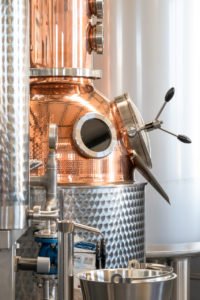
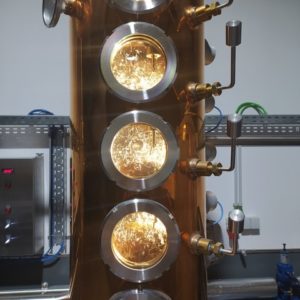
We use a hybrid still with six active plates.
The heads are distilled very slowly, while the hearts are collected at a stable rate of approximately 400 millilitres per minute.
We collect the heart at the upper legal alcohol limit, giving us a particularly clean spirit.
What role does maturation play in your range, and how does Madeira’s climate influence ageing?
We are moving towards a range composed almost entirely of aged spirits.
Our focus is on local wood and on maturation conditions that are specific to our location. The distillery stands at approximately 600 metres above sea level, where we experience pronounced variations between daytime and nighttime temperatures, but lower average temperatures than at sea level.
We believe this gives us the best of both worlds: a lower angel’s share, combined with frequent expansion and contraction cycles within the cask.
We monitor and record temperature and humidity at cask level using data loggers.
Do Madeira wine casks or other local casks play a role in your production?
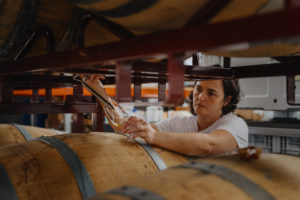
Yes. We use new Portuguese oak and Madeira wine casks.
New Portuguese oak contributes considerable colour and the spicy aromatic profile we prefer to the more conventional vanilla character associated with many other types of oak.
Our Madeira wine casks are also rather particular. We do not simply buy used casks on the open market.
Instead, we import ex-Cognac casks and provide them to H. M. Borges, a small, family-owned Madeira wine producer. The casks are used to mature high-quality Madeira wines before being returned to us for spirit maturation.
We do not use inexpensive former red-wine casks that have been shaved and briefly seasoned with basic cooking Madeira.
What aromas, flavours or textures should tasters associate with your rums?
An unctuous texture, lower perceived acidity and a degree of grassiness that does not overpower the rum’s natural sweetness.
All our rums contain zero residual sugar.
Every rum we produce is intended as a sipping rum, including the unaged expressions. They are designed to be enjoyed neat or over ice.
What do international consumers still misunderstand about Rum da Madeira?
The principal problem is that many international consumers simply do not know Madeira rum.
Those who do encounter it often focus only on the most traditional expressions, characterised by pronounced grassiness and occasionally rather funky aromas.
Madeira rum can, and should, be much more than rum for poncha.
The quality of aged Madeira rum has improved enormously over the past ten years, although greater consistency is still required. The category also needs more innovation, greater openness and a willingness to explore new directions.
In one sentence, what should Rum da Madeira stand for internationally?
Madeira rum should stand for uniqueness and outstanding quality.
Madeira is also much more than fortified wine and traditional agricultural rum. We want people to explore the island’s flavours and discover its distinctive tropical spirits with a European soul.
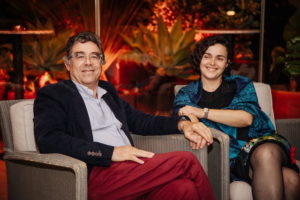
Paulo Mendes, Vinha Alta
For more information on Rum da Madeira, please click here.
The 2026 edition of Spirits Selection by CMB is brought to you in association with:


And with the support of: